
Copilot Credits from 1 December: who pays and how to cap it
For European companies on Microsoft 365: a country-by-country table on whether the 1 December change hits your Copilot Business licences, what it can cost and what to set first.

In this article7
From 1 December 2026, new Microsoft 365 Copilot Business licences bought through CSP partners bill Copilot Credits by default, up to 4,000 credits (USD 40) per user per month. The UK is not on the exclusion list. Germany, France, the Netherlands, Spain, Italy, Belgium and Poland are excluded at launch. Correct as of 21 October 2026.
Your Copilot bill is splitting in two. The seat price stays fixed, and a second, variable line appears next to it that grows with how much your team uses agents. If you run a team across several European countries, the same licence can behave differently depending on where each company is registered.
What changes on 1 December
Microsoft is making usage-based billing the default for new Copilot Business licences sold through the Cloud Solution Provider (CSP) channel, meaning resellers that sell Microsoft licences. The original date was 2 November. Microsoft moved it to 1 December in a partner announcement last updated on 14 October.
Three numbers matter for your budget.
- Default limit. Value: 4,000 credits per user per month. Source: Microsoft Partner Center, October 2026.
- Price per credit (pay-as-you-go). Value: USD 0.01. Source: Microsoft Copilot Credits licensing guidance.
- Minimum per-user limit. Value: 2,000 credits per month. Source: Microsoft Learn, updated 2 October 2026.
A second change lands the same day. From 1 December you can buy Copilot Business without a base Microsoft 365 subscription, at the same price. The current offers were renamed with “(add-on)” on 16 October and reach end of sale in CSP on 1 December. Existing customers can keep renewing them.
Does the 1 December change apply in my country?
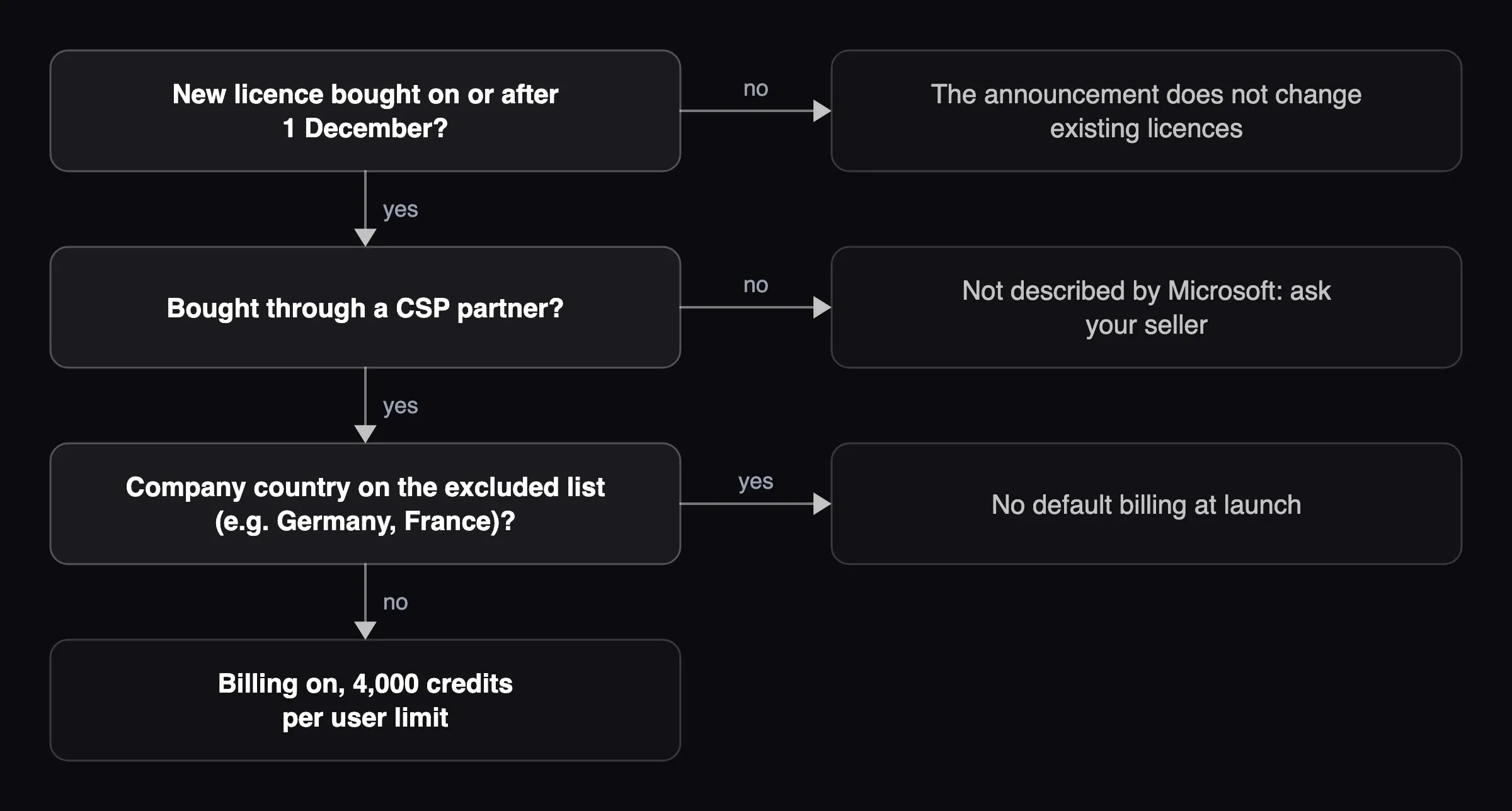
It depends on the market your company sits in, and most of the EU's largest economies are out at launch. Microsoft's exclusion list has eleven markets. In Europe: Belgium, France, Germany, Italy, the Netherlands, Poland and Spain. Outside Europe: Australia, Brazil, India and Korea. Microsoft has not said when that will change.
The exclusion covers the default setting. Microsoft's setup documentation mentions no country limits, so we assume a spending policy set up by hand can bill credits in these countries too. Check it in your own admin centre.
- UK company, new licences from a CSP partner. What happens on 1 December: not on the exclusion list, so billing on by default, 4,000 credits per user. What to do: set limits and alerts on the day you buy.
- Company in Ireland, Sweden, Denmark, Austria or another market not on the list. What happens on 1 December: billing on by default, if Microsoft treats your market as supported. What to do: ask your partner to confirm your market in writing.
- Company in Germany, France, the Netherlands, Spain, Italy, Belgium or Poland. What happens on 1 December: no default billing at launch. What to do: agree limits and owners before Microsoft extends the change.
- Licences bought before 1 December. What happens on 1 December: the announcement covers new purchases only. What to do: check whether anyone has already linked an Azure subscription.
- Bought directly from Microsoft, not through a partner. What happens on 1 December: the announcement does not cover this. What to do: ask your seller in writing.
If your group has a UK subsidiary and a German parent, plan for two different starting points.
What could this cost a 15-person team?
Take the worst case under the defaults. Fifteen people times 4,000 credits is 60,000 credits, or USD 600 a month on top of your licences. That is a ceiling, not a bill.
How fast does a team get there? Microsoft, quoted by CRN, describes light tasks at up to 300 credits, medium tasks at up to 700 and heavy tasks above 700. A medium task is something like preparing a briefing note, a spreadsheet and a slide deck for a meeting from emails and recent files. At that rate, 4,000 credits covers a handful of medium tasks per person each month. For comparison, Microsoft priced the Copilot Business seat at USD 21 per user per month when it launched in December 2025. The default credit limit is almost twice the seat price.
What the licence covers and what costs credits
Everyday Copilot stays in the licence. Chat and Copilot inside Word, Excel, Outlook and Teams do not use credits.
Credits pay for services that run longer and do the work themselves. Microsoft Learn lists these:
- Copilot Cowork, an agent that carries out multi-step tasks across Microsoft 365 on its own,
- Advanced work in SharePoint and OneDrive, meaning tasks across many files or run automatically,
- the Work IQ API, used to plug Microsoft 365 data into your own apps and agents,
- Copilot Managed Runtime, Teams Phone Agent and Code.
One setting is easy to miss. Spending policies have an option that adds new services automatically, and it is on by default. Microsoft's documentation says to turn it off for any policy that shouldn't automatically cover future services. Otherwise every new paid feature joins your budget without anyone deciding.
What this means for your company
Probable conclusion: companies in Germany, France, the Netherlands and the other excluded markets have a window with no fixed end. Use it to decide who may spend credits and on what. Rules agreed after the first invoice cost more. Source: Microsoft's exclusion list, with no expansion date.
Probable conclusion: Cowork carries most of the risk. It uses hundreds of credits per task, and people try it out of curiosity. Source: usage examples from Microsoft quoted by CRN (up to 300, 700 and above 700 credits per task).
Hypothesis to test: adding seats to an existing subscription may bring it under the new billing rules. Some Microsoft partners say so. The announcement points the other way: existing customers can keep renewing and adjusting seat numbers with pricing unchanged. Source: CSP partner Sherweb, 16 October 2026, and Microsoft's October 2026 announcement.
If nobody in your company can explain a line on the AI bill, the problem is not Copilot. Nobody owns it.
What to do this week
An admin with billing access can work through these steps.
- In the Microsoft 365 admin centre, open Copilot, then Cost management, and check whether a spending policy and an Azure subscription already exist.
- Check that the discovery setting for usage-based experiences is off (Copilot, then Settings) until limits are agreed. Users then cannot see those services, unless they are already covered by a spending policy. Microsoft says this setting will be replaced by one that handles access requests.
- Switch off automatic inclusion of new services in each policy.
- Set a monthly limit for the policy and for each user, plus an email alert, for example at 50%.
- Ask your licensing partner in writing which market and channel your company is assigned to, and what changes when you add seats.
If you would rather go through this with people who manage AI licences and costs for companies every day, see our AI administration service. For a wider view of what goes into an AI bill, read AI implementation cost: what you pay for. If you are weighing whether a credit-billed agent will pay for itself, see how much an AI agent costs and when it pays off. We covered similar decisions on limits and access in our Claude Team setup guide, and another vendor-driven change in the GPT-4o API shutdown.
We have not tested this on a live tenant, because default billing only starts on 1 December. This article is based on Microsoft documentation from October 2026 and does not replace a conversation with your licensing partner.
Sources
- Microsoft Partner Center, October 2026 announcements, posted 1 October, updated 14 October 2026, accessed 21 October 2026.
- Microsoft Learn, Managing AI experiences enabled by usage-based billing, updated 2 October 2026, accessed 21 October 2026.
- Microsoft Learn, Set up usage-based billing for Copilot Credits, updated 2 October 2026, accessed 21 October 2026.
- Microsoft Learn, Discovery setting for AI experiences enabled by usage-based billing, accessed 21 October 2026.
- Microsoft, Copilot Credits licensing guidance, accessed 21 October 2026.
- CRN, “Microsoft Enables Consumption Billing By Default For Copilot Business: 5 Things To Know”, October 2026.
Questions & Answers(FAQ)
Yes, for new Microsoft 365 Copilot Business licences bought through a CSP partner. The UK is not on Microsoft's list of excluded markets, so pay-as-you-go billing should be on by default with a limit of 4,000 Copilot Credits per user per month. You pay for credits actually used, not for the whole limit.
Microsoft lists Belgium, France, Germany, Italy, the Netherlands, Poland and Spain among the markets where default billing will initially not be available, alongside Australia, Brazil, India and Korea. Microsoft says it will share more information as availability expands, but has not given a date for any of these countries.
Microsoft lists pay-as-you-go at USD 0.01 per Copilot Credit, billed monthly in arrears. The default limit of 4,000 credits per user therefore caps spending at USD 40 per user per month. A one-year Pre-Purchase Plan gives discounts from 5% at 300,000 credits up to 20% at 300 million, and unused credits expire.
Microsoft's documentation does not describe a zero limit. It states a minimum per-user budget of 2,000 credits a month. To avoid credit spending, do not assign people to a spending policy and do not add services to it. With the discovery setting off, usage-based experiences stay hidden from users outside a policy.
According to Microsoft Learn, users covered by the policy lose access to the agents and services billed in credits for the rest of the month, and credits reset on the first of the next month. Everyday Copilot in Word, Excel, Outlook and Teams keeps working because it is part of the licence. Admins get email alerts at the threshold they set.
About the author

Mateusz Cieśliński
Co-Founder, DevOps Engineer
Matthew Cieslinski is a co-founder and DevOps Engineer at AppWave, a software house that builds AI systems that companies actually use. He specializes in cloud infrastructure (AWS), container environments (Docker) and the operational side of AI deployments - so that they work stably in production, not just in the pilot phase. He operates from Lodz, Poland.
Got a similar process on your side?
If something in this article sounds like your day-to-day - let's talk. We'll tell you plainly what can be improved, and what's not worth touching.
Services related to this topic
Customer service automation
Not another chatbot. An agent wired into your email, CRM and knowledge base that takes over repetitive work.
MVP ready to run
A working system tailored to your process. From 35,000 PLN net, with a clearly defined scope, price and delivery time.
Custom web software
Off-the-shelf tools force you to compromise. We build a system around your process, with AI where it genuinely gives an edge.