
GPT-4o API shutdown: will your company chatbot stop working?
For European business owners whose chatbot was built by an agency on the OpenAI API. Which shutdown date applies to you, what the switch costs and what to ask.
In this article7
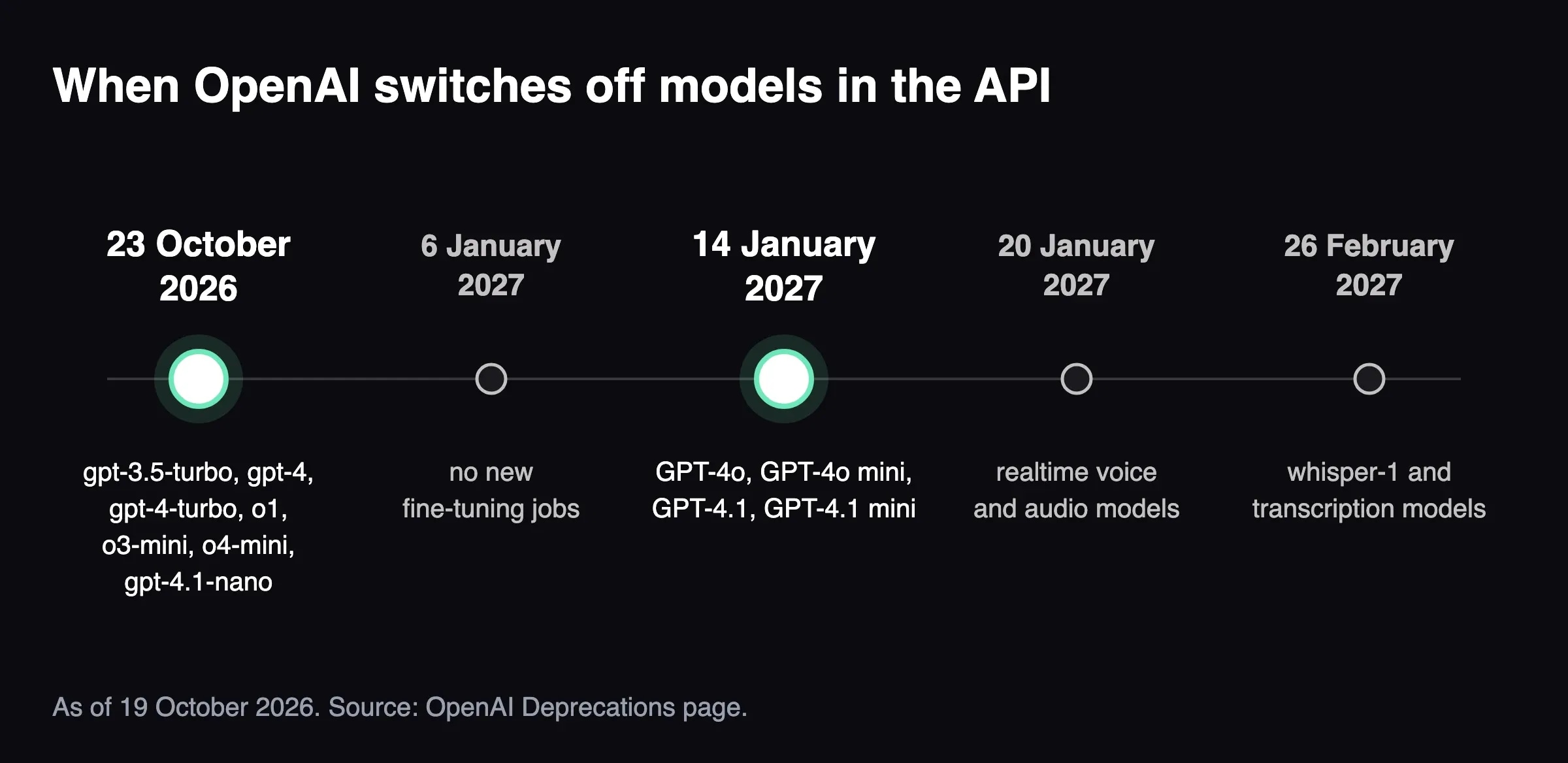
Yes, if your chatbot calls GPT-4o, GPT-4o mini, GPT-4.1 or GPT-4.1 mini through the OpenAI API, it will stop answering on 14 January 2027 unless someone changes the model. OpenAI gave notice on 14 October. Several older models, including gpt-3.5-turbo and gpt-4-turbo, go even sooner, on 23 October 2026. Correct as of 19 October 2026.
The code is rarely the hard part. OpenAI emails the customers actively using a model, which means whoever holds the API account. In many European companies of 10-200 people, that account belongs to the agency or freelancer who built the bot two years ago. If nobody read that email, the first warning will be a customer telling you the chat has gone quiet.
What OpenAI announced on 14 October
From 14 January 2027, the OpenAI API stops serving five model versions from the GPT-4 family. OpenAI's Deprecations page lists them by full ID: gpt-4o-2024-08-06, gpt-4o-2024-11-20, gpt-4o-mini-2024-07-18, gpt-4.1-2025-04-14 and gpt-4.1-mini-2025-04-14. All five point to the same replacement, gpt-6-luna.
Two details are easy to miss.
The notice is shorter than usual. OpenAI's own policy promises at least six months for generally available models, and this notice gives 92 days. The shutdown also covers fine-tuned models, meaning versions trained further on a company's own data. Their successor cannot be fine-tuned at all, and new fine-tuning jobs in the API end on 6 January 2027.
This is separate from GPT-4o leaving the ChatGPT app in February. That change affected people chatting in ChatGPT, while the API stayed as it was. This one reaches the place where business chatbots actually run.
The timing matters for Europe. OpenAI's own report from 14 October says weekly active users of Codex and ChatGPT Work among EU businesses with up to 200 users grew more than eightfold since May 2026. Those are OpenAI's own apps, not API chatbots, but our reading is that small European firms are building more of their work on OpenAI models, and more of them will meet a shutdown date like this one.
Which shutdown date applies to your chatbot
One string in the configuration decides it: the model ID. Without it, nobody can tell you which date applies. For 14 January, OpenAI lists dated versions only and says nothing about short names such as "gpt-4o", so ask for the full ID. The table uses OpenAI's Deprecations page as of 19 October 2026.
- gpt-3.5-turbo, gpt-4, gpt-4-turbo, o1, o3-mini, o4-mini, gpt-4.1-nano, gpt-4o-2024-05-13. What happens: removed from the API. Date: 23 October 2026. What to do: check today, switch this week.
- GPT-4o (August and November 2024 versions), GPT-4o mini, GPT-4.1, GPT-4.1 mini. What happens: removed from the API, replacement gpt-6-luna. Date: 14 January 2027. What to do: plan migration and testing for November.
- a fine-tuned version of any model above. What happens: removed with its base model, Luna cannot be fine-tuned. Date: 14 January 2027 (new jobs until 6 January). What to do: move the knowledge into a knowledge base.
- a voice bot on gpt-realtime or gpt-4o-realtime. What happens: removed from the API. Date: 20 January 2027. What to do: check separately, different replacement.
- call transcription on whisper-1 or gpt-4o-transcribe. What happens: removed from the API. Date: 26 February 2027. What to do: check separately.
- a ready-made chat widget from a platform vendor. What happens: depends on the vendor. Date: no single date. What to do: ask the vendor in writing.
- Azure OpenAI rather than the OpenAI API. What happens: Microsoft runs its own schedule. Date: check with Microsoft. What to do: do not assume OpenAI's dates.
If your chatbot works today and once used the Assistants API, someone has already moved it, because that API shut down on 26 August 2026. If you do not know whether it did, add that to your questions.
What the switch to GPT-6 Luna costs
The model bill itself will probably fall or stay about the same. GPT-6 Luna costs 0.10 USD per million input tokens and 0.50 USD per million output tokens. GPT-4o mini costs 0.15 and 0.60 USD. A token is a fragment of a word, the unit OpenAI bills by.
There is one catch. Luna "thinks" before answering, at medium effort by default, and OpenAI bills those reasoning tokens as output. Take a chatbot handling 10,000 conversations a month at 3,000 input tokens and 300 output tokens each. On GPT-4o mini that comes to about 6.30 USD. On Luna, if reasoning adds 1,000 tokens per answer, it comes to about 9.50 USD [estimate: OpenAI list prices, assumed token counts].
So "how much will this cost us a month" has a small answer for tokens. The larger cost is the supplier's time: changing the model, adjusting instructions and testing on real conversations. OpenAI's model page says that in the Chat Completions interface, one of the ways an application talks to the model, Luna supports tool calls (checking an order status, for example) only with reasoning switched off. Combining both needs the newer Responses API. A bot that looks things up in your systems needs more work than one that only answers questions.
What we see in the market: the email goes to the account, not the company
We asked four AI assistants the question a business owner would ask about an agency-built chatbot. ChatGPT, Gemini, Perplexity and Claude all gave 14 January 2027 correctly. Most of them, though, open with "check your codebase", which an owner without code access cannot do. Gemini suggests Azure may keep old models longer, but the Microsoft retirement page we could reach lists no dates for these models.
The English-language results we checked in the UK and Germany are written for developers: forum threads, a Reddit open letter with over 130 comments, and migration notes about API parameters. None of them is written for the person who pays the invoice.
What this means for your company
Probable conclusion: the companies most at risk are those without access to their own API account. OpenAI says it notifies customers actively using a model by email. If that account belongs to your agency, the notice never reaches you. A supplier who has moved on, or simply stopped reading that inbox, becomes a chat window that goes silent in January.
Probable conclusion: a model change is a good time to ask where your customers' data is processed. For GPT-6 Luna, OpenAI offers EU data residency. If you are switching models anyway, the region setting can change in the same piece of work, which makes the GDPR conversation with your data protection officer simpler.
Hypothesis to test: a new model may answer your customers differently from the old one, even with the same instructions. We do not yet have data on how Luna handles customer service conversations in languages other than English. Testing on your own past conversations matters more than changing one line of code.
Probable conclusion: 92 days instead of six months suggests model providers will change their line-up faster. Maintenance is no longer something you can drop once the chatbot is live.
What to do this week
Five steps that take you about an hour. Your supplier does the rest.
- Email your supplier and ask for the exact model ID in every place that calls OpenAI: the website chat, automated emails and any CRM integration.
- If any ID is on the 23 October list, ask for the switch this week. There are four days left.
- Find out whose name the OpenAI API account is in and which address receives notices. Add a company address you control.
- Ask for a test of the new model on 30-50 real conversations before the switch, and for a quote covering the whole migration, not just the model change. Where the bot makes decisions, keep a person at the risky points, as we describe in our piece on human oversight of AI in a small business.
- If the bot was fine-tuned, ask how that knowledge will move into a knowledge base. We explain the difference in RAG vs fine-tuning: why AI gets your pricing wrong.
While the migration is open, also check the AI text marking setting we cover in the ChatGPT watermark in the EU and the 2 December date. If you are wondering whether to stay with a simple chatbot after the switch, our comparison of a corporate chatbot or an AI agent may help.
If your supplier has gone or stopped replying, you can work through this list with a team that maintains and updates AI systems for companies as its day job.
We have not yet tested GPT-6 Luna on non-English customer service conversations at production scale, so we cannot promise the switch will need no adjustments. The dates come from OpenAI's page as of 19 October 2026 and may change.
Sources
- OpenAI, Deprecations, accessed 19 October 2026: https://developers.openai.com/api/docs/deprecations
- OpenAI, GPT-6 Luna model page (pricing, reasoning, fine-tuning, EU data residency), accessed 19 October 2026: https://developers.openai.com/api/docs/models/gpt-6-luna
- OpenAI, GPT-4o mini model page (pricing), accessed 19 October 2026: https://developers.openai.com/api/docs/models/gpt-4o-mini
- OpenAI, Reasoning models (billing of reasoning tokens), accessed 19 October 2026: https://developers.openai.com/api/docs/guides/reasoning
- OpenAI, The EU's next chapter in AI is agentic, 14 October 2026: https://openai.com/index/the-eus-next-chapter-in-ai-is-agentic/
- OpenAI, Retiring GPT-4o, GPT-4.1, GPT-4.1 mini, and OpenAI o4-mini in ChatGPT, 29 January 2026: https://openai.com/index/retiring-gpt-4o-and-older-models/
- The New Stack, "OpenAI promised developers six months' notice. GPT-4o users got three.", 15 October 2026: https://thenewstack.io/openai-gpt4o-api-shutdown/
Questions & Answers(FAQ)
OpenAI's Deprecations page lists 14 January 2027 as the shutdown date for gpt-4o-2024-08-06, gpt-4o-2024-11-20, gpt-4o-mini-2024-07-18, gpt-4.1-2025-04-14 and gpt-4.1-mini-2025-04-14. OpenAI gave notice on 14 October 2026 and names gpt-6-luna as the replacement. An older snapshot, gpt-4o-2024-05-13, shuts down sooner, on 23 October 2026.
No. OpenAI removed GPT-4o from the ChatGPT app on 13 February 2026 but kept it in the API. A chatbot on your website uses the API, so a separate timetable applies: 14 January 2027 for GPT-4o, GPT-4o mini, GPT-4.1 and GPT-4.1 mini, and 23 October 2026 for several older models.
Ask whoever built it for the exact model ID, such as gpt-4o-mini-2024-07-18, rather than just "GPT-4o". Ask them to check every place that calls OpenAI: the website chat, automated emails and CRM integrations. A developer can also call OpenAI's list of models, where models can carry an optional shutdown_date field, in a few minutes.
The price per token is lower: 0.10 USD per million input tokens and 0.50 USD per million output tokens, against 0.15 and 0.60 USD for GPT-4o mini. Luna reasons by default, though, and reasoning tokens are billed as output. In our example, the difference is about 3 USD a month. Migration work and testing cost more.
Fine-tuned versions of GPT-4o and GPT-4.1 shut down with their base models on 14 January 2027. GPT-6 Luna does not support fine-tuning, and new fine-tuning jobs in the OpenAI API end on 6 January 2027. The knowledge has to move into a knowledge base the model reads at answer time, and the result needs testing.
About the author

Mateusz Cieśliński
Co-Founder, DevOps Engineer
Matthew Cieslinski is a co-founder and DevOps Engineer at AppWave, a software house that builds AI systems that companies actually use. He specializes in cloud infrastructure (AWS), container environments (Docker) and the operational side of AI deployments - so that they work stably in production, not just in the pilot phase. He operates from Lodz, Poland.
Got a similar process on your side?
If something in this article sounds like your day-to-day - let's talk. We'll tell you plainly what can be improved, and what's not worth touching.
Services related to this topic
Customer service automation
Not another chatbot. An agent wired into your email, CRM and knowledge base that takes over repetitive work.
AI implementation review
Before you spend anything - we show, in numbers, where AI pays off and whether it's legal.
MVP ready to run
A working system tailored to your process. From 35,000 PLN net, with a clearly defined scope, price and delivery time.