
Shadow AI in a small company: what personal AI accounts really risk
For owners and managers of European firms with 10-200 staff whose people already use ChatGPT, Claude or Gemini on their own accounts. A table of settings, a cost figure and five steps for this week.

In this article7
Shadow AI, meaning staff doing company work on personal AI accounts, is rarely an AI Act problem for a small firm. The Act's fines target prohibited practices, high-risk systems and transparency duties. The exposure sits in the GDPR, in trade secrets and in shared chat links. Status as of 26 October 2026.
Across Europe, national AI regulators are getting their enforcement powers. In Poland, for example, the commission that supervises the AI Act can inspect and fine companies from 28 October 2026. One Polish broadcaster's article circulated under the headline "the end of free use of AI at work" (our translation). None of the laws involved bans a personal ChatGPT account. The risk is older and more ordinary than that.
Can an AI Act regulator fine you for staff using personal ChatGPT?
For normal office use, there is very little to fine. Article 99 of the AI Act sets penalties for prohibited practices, obligations for high-risk systems, transparency duties and supplying misleading information to authorities. The AI literacy duty in Article 4 is not in that list. Regulation (EU) 2026/1744, the Digital Omnibus on AI, also softened Article 4: companies must take measures to support AI literacy rather than guarantee a level of it.
So an employee who drafts a proposal in a personal ChatGPT account is not committing an AI Act offence. That is the easy part.
What changes country by country is who enforces what. In Poland, articles 8-18 and chapters 3-5, 8 and 9 of the national AI Act take effect on 28 October 2026, according to the act's entry in the official journal. Those cover, among other things, individual opinions, inspections and proceedings before the regulator. We covered what that means for customer-facing chatbots in Chatbot AI Act checklist before 28 October 2026.
Shadow AI: where the risk actually sits
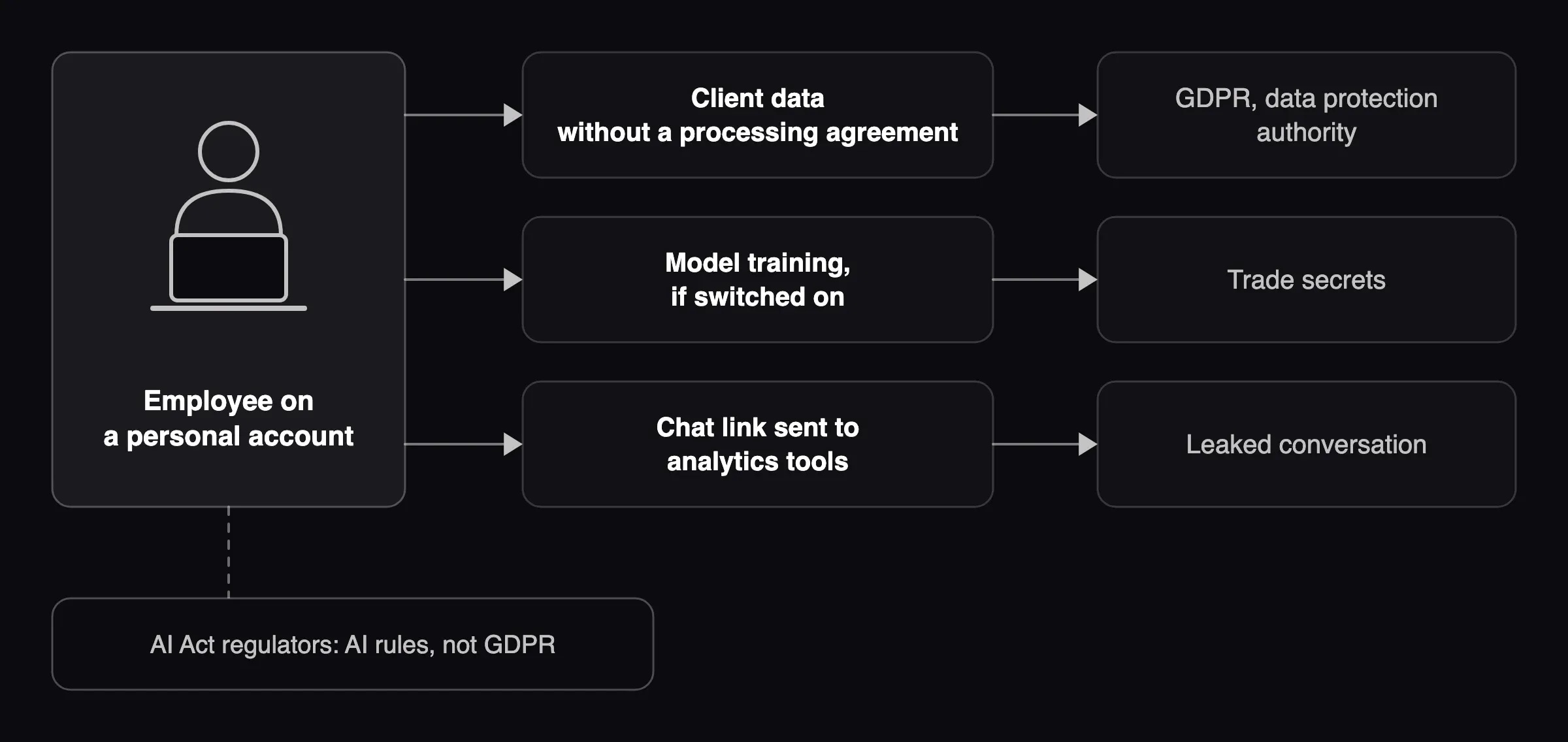
The risk starts the moment something that belongs to a client or to the company goes into a personal account. We see three places.
Personal data without a processing agreement. Your company is the controller of its clients' personal data. When an employee pastes a client email into a personal chat, your company discloses that data to a provider without the processing agreement Article 28 of the GDPR requires. You also cannot delete it when the employee leaves. Data protection authorities enforce this, and they did not need a new date to do so.
Trade secrets. Under the EU Trade Secrets Directive, information is protected only if its holder took reasonable steps to keep it secret. Without any rule on AI tools, that is harder to show for a price list or a client list.
Shared links. In the LeakyLM project, researchers at IMDEA Networks near Madrid tested ChatGPT, Claude, Grok and Perplexity. On all four, conversation URLs reached third parties, including analytics, advertising and support tools. For free logged-in ChatGPT users, the chat URL and title went to Google Analytics. The researchers say they have no evidence that trackers read the conversations. A second fact makes this worse: OpenAI says anyone with a link from a personal account can open the shared chat.
Which accounts train on your chats
The same app behaves differently on a personal and a company account. We put the vendors' help pages side by side, as of 26 October 2026.
- ChatGPT Free, Plus, Pro. Personal account: data sharing for training is on by default. What to switch off: settings, Data controls, "Improve the model for everyone". Company version: ChatGPT Business: no training by default, data processing agreement, links open only to workspace members.
- Claude Free, Pro, Max. Personal account: trains only if the user agreed; then chats are kept up to 5 years, otherwise 30 days. What to switch off: the model improvement choice in privacy settings. Company version: Claude Team and Enterprise run on commercial terms, outside this scheme.
- Gemini on a personal Google account. Personal account: with activity on, chats train models and some are read by human reviewers; reviewed chats are kept up to 3 years. What to switch off: "Keep activity"; with it off, chats stay 72 hours. Company version: gemini in Google Workspace: no training without permission, no human review.
- Copilot. Personal account: we did not check the consumer version. What to switch off: data not available. Company version: Microsoft 365 Copilot Chat with a work Entra account: enterprise data protection, prompts do not train models.
Turning training off on a personal account lowers the risk. It still leaves you without a contract.
What we see in the market: bans push AI onto phones
KPMG's study of trust in AI, with 1,082 respondents in Poland, found that 55% of Polish employees who use AI do not disclose it and present the output as their own. Almost 90% of users rely on public tools, and 77% of those use free ones. We have not found comparable figures for other EU countries.
A ban without an alternative moves the problem to personal phones. Then you see nothing.
The alternative has a price you can work out. OpenAI lists a ChatGPT Business Standard seat at 20 US dollars per user per month billed annually, or 25 dollars monthly, from two users. For 40 people on annual billing that is 9,600 dollars a year before tax. If you already pay for Microsoft 365 or Google Workspace, a chat with enterprise data protection may already be in your subscription. We explain the setup in Microsoft 365 Copilot Business setup for small companies and, for Anthropic, in Claude Team plan setup for business.
What this means for your company
Probable conclusion. National AI Act enforcement dates do not change the risk of personal AI accounts. The first letter about it is more likely to come from a client, or from a data protection authority after an incident, than from an AI regulator.
Probable conclusion. The cheapest fix is a one-page rule, not a new tool. Firms on Microsoft 365 or Google Workspace may already pay for a protected chat.
Hypothesis to test. Larger customers increasingly ask suppliers in security questionnaires whether their data goes into AI tools. If that has started in your sector, AI rules become a condition of winning work.
What to do this week
Five steps you can take without an IT department.
- Ask your team what they use AI for, not whether they use it. Make it anonymous. Note the tool, the kind of data and the account type.
- Write one page: which tools we use, on which accounts, and what never goes in (client data, staff data, contracts, passwords).
- Check what you already pay for. Copilot Chat in Microsoft 365 and Gemini in Workspace run on work accounts with data protection.
- Ask people to switch off "Improve the model for everyone" in personal ChatGPT and to delete old links under Data controls, Shared links, Manage.
- If you would rather go through this with someone who does it every week, our AI audit starts from the list of tools already running in your company, and you know what we check, why and what it costs before we start.
We are not a law firm or a data protection officer, and this is not legal advice. We compared the vendors' help pages; we did not test every setting on every plan.
Sources
All pages accessed on 26 October 2026.
- Regulation (EU) 2024/1689 (AI Act), Articles 4 and 99: EUR-Lex.
- Polish Act of 3 July 2026 on AI systems, official journal entry: eli.gov.pl.
- OpenAI, Data Controls FAQ, ChatGPT Shared Links FAQ, ChatGPT Business pricing.
- Anthropic, Updates to our consumer terms, 28 August 2025.
- Google, Gemini Apps Privacy Hub, Generative AI in Google Workspace Privacy Hub.
- Microsoft, Copilot Chat FAQ.
- Directive (EU) 2016/943 on trade secrets, Article 2: EUR-Lex.
- RMF FM, article of 28 September 2026 (Polish).
- IMDEA Networks, LeakyLM.
- KPMG Poland, press release on AI use at work.
Questions & Answers(FAQ)
No EU law bans it. The AI Act's penalties in Article 99 mainly target prohibited practices, high-risk systems and transparency duties, and the AI literacy duty in Article 4 is not on that list. The real exposure is under the GDPR: if staff paste client personal data into a personal account, the provider receives it without the processing agreement Article 28 requires.
It helps, but it is not enough. Switching off "Improve the model for everyone" stops new chats being used to train OpenAI's models. It does not give your company a data processing agreement or control over the account when someone leaves. On Free, Plus and Pro, data sharing is on by default.
According to the vendors' own help pages, ChatGPT Business, Enterprise and Edu, Claude Team and Enterprise, Gemini in Google Workspace and Microsoft 365 Copilot Chat signed in with a work Entra account do not use your prompts to train models by default. Check the terms of your specific edition before you rely on it.
OpenAI lists a ChatGPT Business Standard seat at 20 US dollars per user per month billed annually, or 25 dollars billed monthly, starting at two users. For a 40-person company on annual billing that comes to 9,600 dollars a year before tax. If you already pay for Microsoft 365 or Google Workspace, check what is included first.
Yes. OpenAI says a link made on a personal account opens for whoever receives it, while links from a Business workspace open only for its members. Researchers behind the LeakyLM project also found chat URLs being sent to third-party trackers. Delete old links under Data controls, Shared links, Manage.
About the author

Mateusz Cieśliński
Co-Founder, DevOps Engineer
Matthew Cieslinski is a co-founder and DevOps Engineer at AppWave, a software house that builds AI systems that companies actually use. He specializes in cloud infrastructure (AWS), container environments (Docker) and the operational side of AI deployments - so that they work stably in production, not just in the pilot phase. He operates from Lodz, Poland.
Got a similar process on your side?
If something in this article sounds like your day-to-day - let's talk. We'll tell you plainly what can be improved, and what's not worth touching.
Services related to this topic
AI implementation review
Before you spend anything - we show, in numbers, where AI pays off and whether it's legal.
Customer service automation
Not another chatbot. An agent wired into your email, CRM and knowledge base that takes over repetitive work.
MVP ready to run
A working system tailored to your process. From 35,000 PLN net, with a clearly defined scope, price and delivery time.