
Is ChatGPT safe for confidential information? Where company data goes
For owners and managers of 10-200 person firms in the UK and EU who want AI but worry about customer data. A table of five places where copies sit, and six questions for a supplier.

In this article9
Data you send to AI goes to the model provider and, in a custom-built system, to your supplier's application too. OpenAI and Anthropic say they do not train their models on business-account data by default. Personal accounts are different. So is ChatGPT safe for confidential information? It depends on the account and the contract. Correct as of 26 November 2026.
This is one of the questions companies ask us before a project starts. It matters because you are responsible for your customers' data even when another firm handles it for you.
What happens to the data we send to AI? The short answer
It goes to named companies, for a set time, under a contract you can read. A language model, the program that writes the answers, runs on the provider's servers: OpenAI, Anthropic, Google or Microsoft. To answer, it has to receive the question together with whatever data is in it.
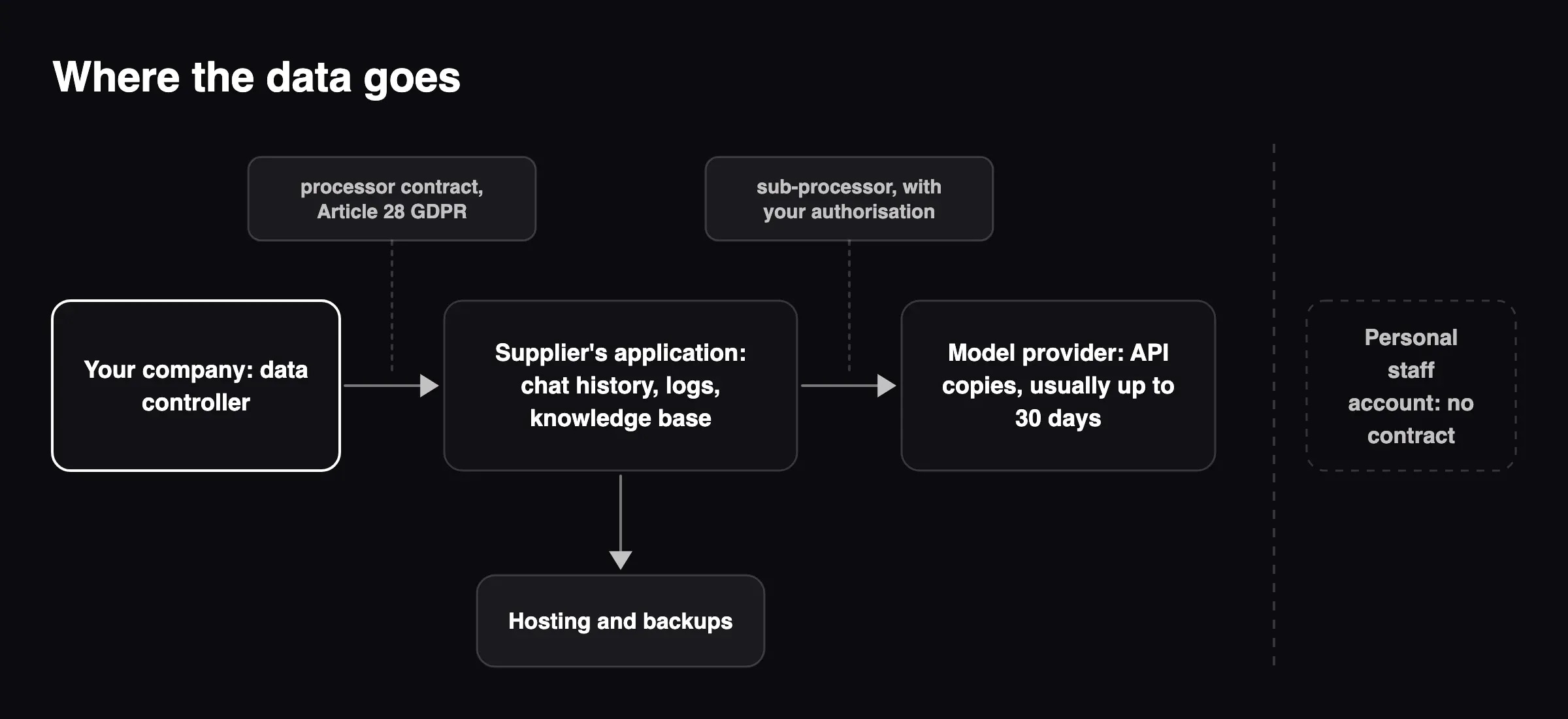
Think of an outside payroll bureau. You hand over salaries and bank details, you sign a data processing agreement, and you know the bureau runs on someone else's payroll software. AI works the same way, with more links in the chain: you, your supplier, the model provider and the hosting company.
Article 28 of the GDPR requires a contract with anyone who handles personal data for you, and your written authorisation, specific or general, for the sub-processors they bring in. The UK GDPR asks for equivalent terms. You already have one with the payroll bureau. Without one, getting data deleted is hard to enforce.
Is ChatGPT safe for confidential information at work?
It depends on the account. Same tool, different rules.
One term first. A provider can “train” its model on your conversations, which means using them to improve the program for every other customer. That is what most firms fear.
On business plans OpenAI says it does not do this by default. That covers ChatGPT Business and ChatGPT Enterprise. The same goes for the API, the connection one program uses to send data to another, which is how a model is plugged into a custom-built system. API logs kept to detect abuse are retained for up to 30 days. OpenAI will sign a data processing addendum (DPA). For customers in the European Economic Area (EEA) and Switzerland the contracting entity is OpenAI Ireland.
The other large providers say much the same. Anthropic says that by default it does not train on data from its commercial products, unless you send feedback on an answer or opt in. It deletes API inputs and outputs from its systems within 30 days, and can keep content flagged for breaking its rules for up to 2 years. Google says Workspace content is not used to train models outside your domain without permission. Microsoft says prompts sent to models sold through Azure are not available to OpenAI and are not used for training without your permission.
A personal account is different. OpenAI may use the content for training unless the user opts out, and your company has no contract with the provider at all. We covered that case, with the cost of business accounts, in our piece on staff using personal AI accounts.
Then there is the question of which country the data sits in. Not every provider keeps it in Europe. OpenAI offers a European region (EEA and Switzerland) for its API, but you have to contact their sales team and choose it when the project is set up. For models released on or after 5 March 2026 it costs 10% more, and its UK region covers storage only. Anthropic lists just two regions for its own API: “us” and “global”. Google's Vertex AI and Microsoft's Azure offer processing inside the EU. You do not need to memorise this. Ask your supplier which country the data sits in, and get the answer in writing.
An example: an online shop, 25 people, 150 emails a day
Take an online shop that wants an AI agent, a program that answers customers and carries out simple tasks, to handle “where is my order” emails. Assume 150 a day. Each holds a name, an email address, an order number and sometimes a delivery address.
That data lands in four places at once. It stays in the shop's inbox and order system. It goes to the supplier's application, which keeps the chat history and the logs, a record of what the agent did. It goes to the model provider. And it sits in backups on a server.
Do the sums. If the model provider keeps copies for 30 days, it holds up to 4,500 conversations at any moment [estimate: 150 × 30]. If you agree 90 days of history with your supplier, their application holds 13,500 [estimate: 150 × 90]. And if nobody agreed anything? All of them stay.
The model provider has published terms you can check. The supplier's application is described by your contract and nothing else.
Where the data goes: five places in one table
The four places from the example, plus one that is easy to forget: a personal staff account. Drawn from what providers publish and what the GDPR requires. Correct as of 26 November 2026.
- A personal staff account. Does anyone train models on it?: in ChatGPT, yes, unless the user opts out. How long does it stay?: the employee decides, not the company. Who is responsible, and what to do: no contract. Give people business accounts.
- A business account: ChatGPT Business, Claude for Work, Gemini in Workspace. Does anyone train models on it?: not by default. How long does it stay?: chats stay until someone deletes them. Check the admin settings. Who is responsible, and what to do: the provider. Sign its DPA.
- A model reached through the API in a custom build. Does anyone train models on it?: not by default (OpenAI, Anthropic). How long does it stay?: OpenAI: abuse logs for up to 30 days. Anthropic: deleted within 30 days. Who is responsible, and what to do: depends whose account it runs on. Put it in the contract.
- The supplier's application: chat history, logs, knowledge base. Does anyone train models on it?: they should not. Ban it in the contract. How long does it stay?: for as long as you agree. With no clause, indefinitely. Who is responsible, and what to do: the supplier. Set a period and deletion at the end.
- Hosting and backups. Does anyone train models on it?: no. How long does it stay?: for as long as backups are kept. Who is responsible, and what to do: the supplier's sub-processor. Name the country or region.
A knowledge base is the set of your documents the agent draws its answers from: price lists, terms, manuals. It is a copy of company data too, and it also sits with the supplier.
What to ask a supplier
Put these to any firm, including us. Each comes with what a good answer sounds like.
- Which data reaches the model at all? A good answer is a list of fields, not “just what is necessary”.
- Whose account with the model provider does the agent run on? You should hear a company name. Ask too whether the access keys, the passwords the program uses to reach the provider, are yours alone or shared with the supplier's other clients.
- What does your application store, and for how long? Expect a number of days for chat history, for logs and for backups, each stated separately.
- Who on your side can read our customers' conversations? A good answer names job roles and says whether every view is logged.
- Which sub-processors do you use, and in which countries? Expect a list of names. If data leaves the EEA or the UK, ask on what legal basis.
- What happens to the data when the contract ends? Article 28 says delete or return. Ask for a deadline and written confirmation.
For questions about code ownership and handover, see seven questions to ask a software development company.
What we see in the market: AI assistants talk about the account, not the supplier
On 26 November 2026 we put the question “What happens to the data we send to AI?” to four assistants with web search: ChatGPT, Gemini, Perplexity and Claude. In English and in Polish: eight answers.
Seven of the eight mention a data processing agreement. One names Article 28. None gives a retention period with a source, and none treats the supplier and the model provider as two separate firms with two separate contracts. Not one says plainly who at the supplier can read the conversations.
Google's automatic summary above the UK results for our headline question, checked the same day, does split consumer and business plans and mentions the DPA. It says nothing about the supplier.
It is a common worry. According to Eurostat, among EU businesses that considered AI and did not use it, almost half (48.83%) cited data protection and privacy concerns. The figure is for 2025 and covers businesses with 10 or more employees.
What this means for your company
Confirmed conclusion. OpenAI, Anthropic, Google and Microsoft all state that they do not train models on data from business plans by default; OpenAI, Anthropic and Microsoft say the same for their APIs. The choice of model provider is therefore rarely the biggest risk. Source: the providers' privacy pages, accessed 26 November 2026.
Probable conclusion. The least documented place is the supplier's application: chat history, logs and backups. Model providers publish retention periods; a supplier is bound by whatever your contract says. Source: our test of eight AI assistant answers, and Article 28 GDPR.
Hypothesis to test. If your own customers require data to stay in the EEA or the UK, your options narrow: with some providers a European region takes a separate arrangement or another cloud in between. Check before the build starts. Source: OpenAI and Anthropic data residency pages.
What to do this week
Five steps. You can do the first one yourself in an hour.
- Write down on one page which data the agent or chat tool would see: fields, not categories. Mark which are personal data.
- Find out which accounts your people use for AI today. Replace personal accounts with business ones.
- Send your supplier the six questions above and ask for answers in writing.
- Check that you have a data processing agreement with the supplier and that it covers deletion when the service ends.
- If you would rather go through this with people who do it every week: when we build AI agents, we agree with you which data reaches a model and which stays on your own servers. The aim is that after go-live you can say yourself where every copy sits, and are not left with a system you do not understand.
If the agent will also send or change things, decide what a person must approve. Our piece on human oversight of AI in a small business shows how.
We are not a law firm or a data protection officer, so ask a lawyer to check your data processing agreement. We did not test settings inside provider accounts; we compared their published pages and terms. We did not check which provider entity contracts with UK customers, or the UK rules on transfers abroad, so UK readers should confirm both with the ICO's guidance. And we do not promise that data will never leave Europe: that depends on the provider we choose together.
Sources
All pages accessed 26 November 2026.
- OpenAI, Enterprise privacy, updated 8 January 2026; Your data; Data residency; Data Processing Addendum, effective 1 January 2026; How your data is used to improve model performance.
- Anthropic, Is my data used for model training?, updated 18 August 2026; How long do you store my organization's data?, updated 1 July 2026; Data residency.
- Google, Generative AI in Google Workspace Privacy Hub, 6 October 2026; Data residency, 24 November 2026.
- Microsoft, Data, privacy, and security for Models sold by Azure in Microsoft Foundry, updated 5 June 2026.
- Regulation (EU) 2016/679 (GDPR), Article 28: EUR-Lex.
- ICO, What needs to be included in the contract?, 8 September 2026.
- Eurostat, Use of artificial intelligence in enterprises, 2025 data.
Questions & Answers(FAQ)
It goes to the model provider and, in a custom-built system, also to your supplier's application and the server it runs on. OpenAI and Anthropic say that on business accounts and through their APIs they do not train models on it by default, and API copies are usually deleted within 30 days. How long your supplier keeps it depends on the contract you sign with them.
On a business account (ChatGPT Business or Enterprise), OpenAI does not train on your data by default and will sign a data processing addendum. On a member of staff's personal account your company has no contract and no say over the conversation, and content may be used for training unless the user opts out. The same tool gives two different levels of protection.
Not always. OpenAI lets you pick a European region for its API, but you choose it when the project is created and must contact sales first; its UK region covers storage only. Anthropic lists just “us” and “global” for its own API. Google's Vertex AI and Microsoft's Azure offer EU processing. If data leaves the EEA or the UK, ask your supplier on what legal basis.
Yes, if the agent handles personal data of your customers or staff. Article 28 of the GDPR, and the same article of the UK GDPR, requires a contract covering documented instructions, confidentiality, security, the use of sub-processors, and deletion or return of the data when the service ends. The UK GDPR asks for equivalent terms. The model provider is then a sub-processor that you authorise.
It depends on how the supplier built the system, which is why you should ask. Chat history and logs sit in their application, so access belongs to whoever they have given it to. Ask for the list of roles with access, whether every view is logged, and for the confidentiality commitment that Article 28 requires.
About the author

Mateusz Cieśliński
Co-Founder, DevOps Engineer
Matthew Cieslinski is a co-founder and DevOps Engineer at AppWave, a software house that builds AI systems that companies actually use. He specializes in cloud infrastructure (AWS), container environments (Docker) and the operational side of AI deployments - so that they work stably in production, not just in the pilot phase. He operates from Lodz, Poland.
Got a similar process on your side?
If something in this article sounds like your day-to-day - let's talk. We'll tell you plainly what can be improved, and what's not worth touching.
Services related to this topic
Customer service automation
Not another chatbot. An agent wired into your email, CRM and knowledge base that takes over repetitive work.
AI implementation review
Before you spend anything - we show, in numbers, where AI pays off and whether it's legal.
Custom web software
Off-the-shelf tools force you to compromise. We build a system around your process, with AI where it genuinely gives an edge.