
ChatGPT Business Hub in the UK and EU: who can claim and what to check
For owners and marketing leads in European companies of 10-200 people: a decision table by business type, who should pass verification, and what a claimed profile will not change.
In this article7
Since 10 November 2026, a company in the UK or the EU can claim its profile in ChatGPT Business Hub, correct its details and see how often ChatGPT mentions it. You cannot launch a Business Agent from Europe, because agents are US-only. Local businesses outside the US cannot claim a listing yet. Status as of 13 November 2026.
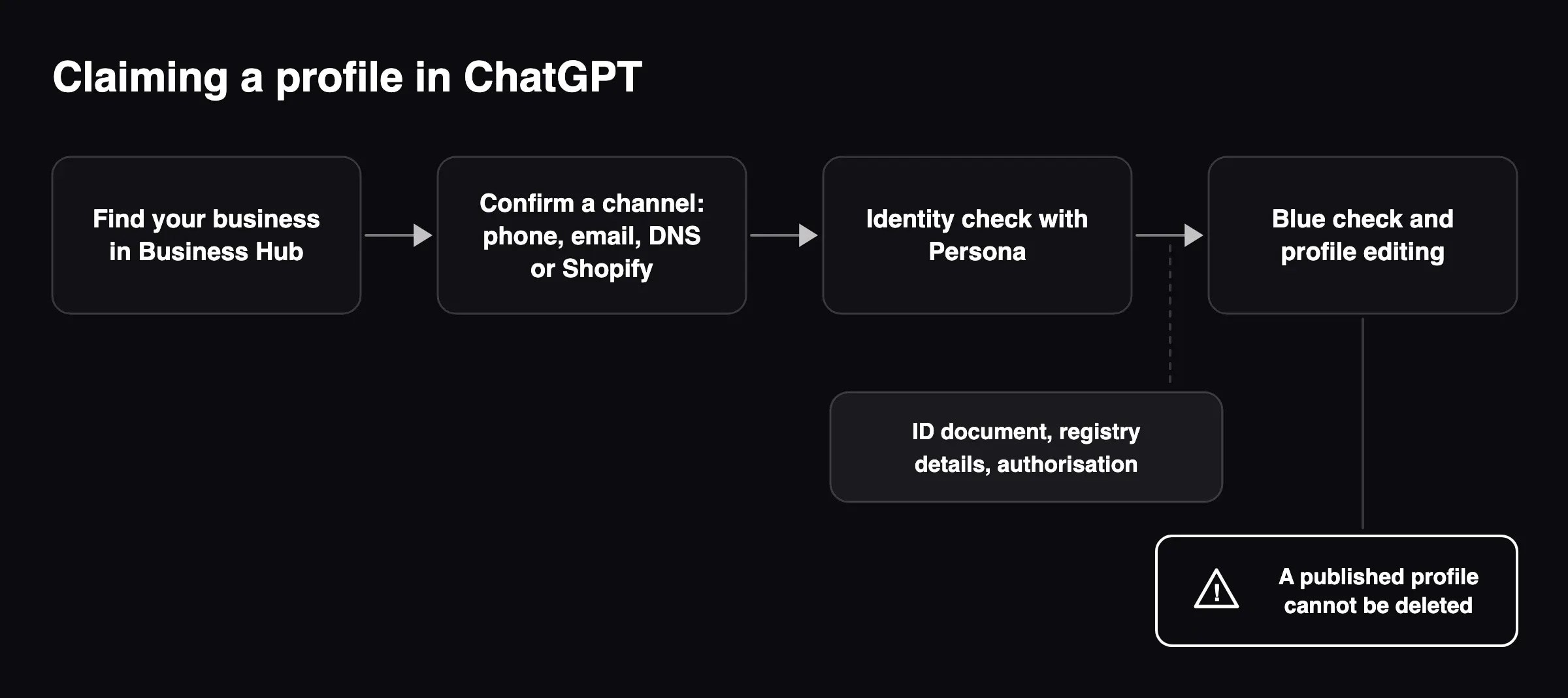
Two things make this more than a marketing chore. A published profile cannot be deleted. And verification is done by a named person, with their passport or ID card.
What OpenAI launched on 10 November
OpenAI announced Businesses in ChatGPT in beta. The control panel is Business Hub, at chatgpt.com/business-hub. The same announcement went up on the OpenAI developer forum that evening.
Inside Business Hub you can do four things:
- claim the profile ChatGPT already has for your business, or add a missing one,
- edit your website, description, category, logo, delivery and returns policies,
- connect a product feed, a file with your prices and stock,
- see 28 days of aggregated insights: mentions, website clicks and discovery topics.
OpenAI reviews every edit before it goes live. Changes do not show up in answers straight away.
ChatGPT Business Hub in Europe: what works and what does not
Short version: profile yes, agent no. OpenAI lets eligible businesses claim a profile wherever ChatGPT is available and verification is supported. The Business Agent, an assistant that answers customers inside ChatGPT, is limited to eligible US ecommerce and online service businesses.
The OpenAI help centre adds a second limit that matters more for many European firms. Local businesses, such as restaurants and shops with a physical location, can currently claim only an existing US listing. So your business type decides more than your country does.
- Online shop on Shopify. Claim a profile: yes. Product feed: yes, by connecting the store. Business Agent: no (US only). What to do now: claim, connect the store.
- Online shop on WooCommerce, PrestaShop, Magento or similar. Claim a profile: yes. Product feed: yes, a CSV upload or a hosted file that follows OpenAI's feed specification. Business Agent: no. What to do now: claim; add a feed only if someone will keep it current.
- Service business with a website (B2B, online services). Claim a profile: yes. Product feed: usually not relevant. Business Agent: no. What to do now: claim, complete the description and contact details.
- Local business (restaurant, clinic, high-street shop). Claim a profile: not yet, US listings only. Product feed: no. Business Agent: no. What to do now: keep your website and Google Business Profile accurate; revisit when the rules change.
The platform question splits Europe. In the DataForSEO technology database on 13 November 2026, Shopify shows 54,062 domains assigned to the UK but only 2,600 assigned to Poland, where WooCommerce shows 35,889. A UK shop is far more likely to connect its catalogue in one click. Elsewhere, someone has to build a feed file and keep its prices in line with the shop.
Who in your company should verify
Verification has two stages. First you prove that you control a business channel: a business phone number, business email, a DNS record on your domain or a Shopify store. Then Persona, a third-party identity provider, checks the person: a government-issued ID, company registration details and proof that they may act for the business. The blue check appears only after both.
That leaves three decisions no tutorial will make for you.
Who. The person should be someone who can represent the company on the public register (a director listed at Companies House, a Geschäftsführer in the Handelsregister) or who holds written authorisation. Not the newest hire in marketing.
Which account. You can give teammates or an agency access, but each person signs in with their own ChatGPT account. The risk: if someone claims the profile from a personal account and later leaves, you may lose access to the panel. We covered why personal AI accounts are a risk in our piece on shadow AI.
Whose data. Persona, not your own team, checks the ID. It is an employee's personal data under GDPR, so agree internally who is comfortable providing it.
The first problems surfaced on the OpenAI forum within a day. UK sole traders who are not VAT-registered report failing Persona because the VAT field is mandatory. Others say the DNS confirmation window is about 30 minutes, too short for some registrars. We found no public answer from OpenAI to either by 13 November.
What we see in the market: AI assistants already get this right
On 13 November we asked ChatGPT, Perplexity, Gemini and Google's AI Mode the same question. All four gave the same answer as the sources: claiming yes, agents no, verification through Persona. That is unusual for a three-day-old feature.
What they do not give you is a view of your own situation. Most of the guides in the top 20 on Google UK are written for US businesses, and none splits the decision by business type and platform.
The regulatory context has also shifted. On 31 August 2026 the European Commission designated ChatGPT a very large online search engine under the Digital Services Act, with 159.1 million average monthly active users in the EU as reported by OpenAI. ChatGPT is now formally a place where Europeans search for suppliers.
What this means for your company
Confirmed conclusion: claiming alone will not make ChatGPT recommend you. OpenAI says claiming does not guarantee more visibility, and ChatGPT, Perplexity, Gemini and Google's AI Mode all repeat it. The profile is for fixing errors and for measurement.
Probable conclusion: Business Hub insights will not be enough for a small company. A blank metric can mean activity below the reporting threshold rather than zero. For online businesses, a mention counts when ChatGPT cites your website, not just your name. If someone asks "how will you measure it?", a fixed list of 20-50 real customer questions, asked every month, gives a better answer. We explain the method in does AI mention your company.
Hypothesis to test: when agents reach Europe, the companies that benefit will be those with clean, current information on products, prices and returns. The agent will answer from whatever you give it. If a wrong answer to a customer is your main worry, that is a good reason to organise this data now and test it against your own past customer conversations.
What to do this week
Five steps, in this order:
- Search for your business at chatgpt.com/business-hub and check whether a profile already exists or has been claimed. Do not publish anything in a hurry: you can delete a draft, not a published profile.
- Pick the person who will verify: someone on the public register or with written authorisation, using an account the company keeps.
- Prepare details that match your registry entry exactly: legal name, registered address, company and VAT numbers. If you use a DNS record, set a short TTL with your domain provider first.
- Before you edit the description, record a baseline: ask ChatGPT 20 questions your customers ask and note how often your name or website appears.
- If you need an assistant that answers customers today, run it on your own website and channels, where you control the data and the answers. Our chatbot vs AI agent comparison and the piece on customer service automation cover the trade-offs. If you would rather work through it with people who build AI agents every week, talk to us.
We have not been through Persona verification with a European company and do not know how long it takes. We are not an OpenAI partner or a law firm, so questions about sharing an employee's ID belong with your data protection officer.
Sources
- OpenAI, "Introducing Businesses in ChatGPT", 10 November 2026: https://openai.com/index/introducing-businesses-chatgpt/
- OpenAI Help Center, "Setting up your business on ChatGPT": https://help.openai.com/en/articles/20001635-setting-up-your-business-on-chatgpt
- OpenAI developer forum, announcement and replies, 10-12 November 2026: https://community.openai.com/t/introducing-businesses-in-chatgpt-in-beta/1414865
- European Commission, list of designated VLOPs and VLOSEs (accessed 13 November 2026): https://digital-strategy.ec.europa.eu/en/policies/list-designated-vlops-and-vloses
- TechCrunch, 10 November 2026, report on OpenAI's press briefing.
- DataForSEO, Domain Analytics and SERP data, 13 November 2026.
Questions & Answers(FAQ)
Yes, if it is an online business or a service business with a website. OpenAI lets eligible businesses claim a profile wherever ChatGPT is available and verification is supported, but publishes no country list, so check in the panel. Local businesses such as restaurants and high-street shops can currently claim only existing US listings. Status as of 13 November 2026, in beta.
No. A Business Agent, the company assistant that answers customers inside ChatGPT using information you provide, is available only to eligible US ecommerce and online service businesses. OpenAI has not given a date for the UK, the EU or the wider EEA. The profile and the insights work without an agent.
First you prove control of a business channel: a business phone number, business email, a DNS record on your domain or a Shopify store. Then Persona, a third-party identity provider, checks the person: a government ID, company registration details and proof of authority to represent the business. Details should match your official registry entry.
OpenAI lists no fee for claiming a profile or using Business Hub, and you do not need an ads account or an Enterprise agreement. Separate paid products exist, such as ChatGPT Business seats and ChatGPT ads. The beta terms may change, so check OpenAI's own pages before you decide.
There is no such guarantee. OpenAI states that claiming does not guarantee more visibility or give you control over ChatGPT's independent recommendations, and the model still reads your website, reviews and other sources. A claimed profile helps you correct wrong details and gives you 28-day insights on mentions, website clicks and discovery topics.
About the author

Mateusz Cieśliński
Co-Founder, DevOps Engineer
Matthew Cieslinski is a co-founder and DevOps Engineer at AppWave, a software house that builds AI systems that companies actually use. He specializes in cloud infrastructure (AWS), container environments (Docker) and the operational side of AI deployments - so that they work stably in production, not just in the pilot phase. He operates from Lodz, Poland.
Got a similar process on your side?
If something in this article sounds like your day-to-day - let's talk. We'll tell you plainly what can be improved, and what's not worth touching.
Services related to this topic
Customer service automation
Not another chatbot. An agent wired into your email, CRM and knowledge base that takes over repetitive work.
AI implementation review
Before you spend anything - we show, in numbers, where AI pays off and whether it's legal.
MVP ready to run
A working system tailored to your process. From 15,000 PLN net, with a clearly defined scope, price and delivery time.